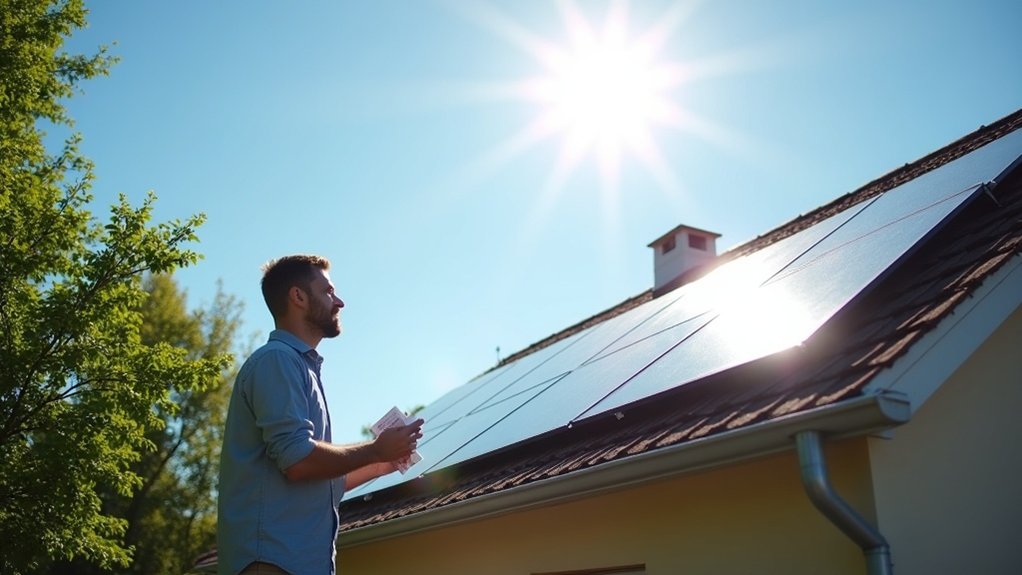
You qualify for free solar panels if your household meets specific income thresholds and receives means-tested benefits under government schemes like ECO4, which often require improvements to your property’s Energy Performance Certificate (EPC) rating. Additional support is available through LA Flex for households in fuel debt or vulnerable situations. Eligibility depends on financial status, EPC rating, and energy needs, so verifying these factors is essential. Exploring these criteria further can clarify your options and application steps.
Understanding Eligibility Criteria for Free Solar Panels
Although many homeowners express interest in installing solar panels, eligibility for free installations is limited by specific criteria centered on household circumstances, particularly income level and receipt of designated means-tested benefits. You need to understand that only about 13% of the 27 million UK households without solar panels qualify for grants covering installation costs. The ECO4 scheme, for example, offers up to 100% coverage but requires demonstrable improvements in your home’s Energy Performance Certificate rating. Access is tightly controlled, focusing heavily on your financial situation and energy needs. If you’re in fuel debt or receive certain benefits but don’t meet standard ECO4 criteria, you might still qualify for additional support via schemes like LA Flex, designed to assist those in more vulnerable positions. The scheme specifically targets homes rated EPC band D to G, ensuring that energy efficiency improvements are made where they are most needed.
Government Schemes Offering Free Solar Panels
Government initiatives play a significant role in making solar panel installation accessible to low-income and vulnerable households by offering financial support that can cover the entire cost. Programs like the ECO4 Scheme provide up to 100% funding for solar panel installation but focus on households receiving specific means-tested benefits and require improvements to the home’s Energy Performance Certificate (EPC) rating. Additionally, the LA Flex extension allows local councils to assist deprived households that don’t meet standard ECO4 criteria, such as those in fuel debt. The Warm Homes: Local Grant program offers up to £30,000 for energy efficiency upgrades, including solar panels, targeting low-income households with poor EPC ratings. Overall, these schemes aim to reduce financial barriers while improving energy efficiency in qualifying homes. Furthermore, participants with solar panels can benefit from the Smart Export Guarantee by receiving payments for surplus electricity they export back to the grid.
How to Assess Your Household’s Qualification
How can you determine if your household qualifies for free solar panels under current schemes? Start by checking if you meet the eligibility criteria of the ECO4 scheme, which targets low-income and vulnerable households receiving specific means-tested benefits. Since only about 13% of the 27 million UK households without solar panels qualify for grants, it’s essential to carefully compare your circumstances against these strict requirements. You can use unofficial eligibility calculators to get an initial assessment, but official confirmation requires a formal application. Your home’s Energy Performance Certificate (EPC) rating also plays a role, as ECO4 demands improvements to EPC ratings for qualification. Additionally, if you’ve been in fuel debt for over 13 weeks or repaid it via third-party deductions, you might qualify through the LA Flex extension. The EPC provides a standardized energy rating that can influence eligibility for energy efficiency improvements under government schemes.
Alternative Options for Solar Panel Installation
If your household does not meet the criteria for grants like ECO4, there are still viable alternatives to evaluate for solar panel installation. One popular option is the solar subscription model, which requires no upfront costs and offers customized solar and battery packages tailored to your energy needs. Programs like Sunsave Plus enhance this approach by providing 24/7 monitoring and downtime coverage, ensuring your system operates efficiently without additional effort on your part. Subscription services often include insurance against damage, fire, and theft, protecting your investment thoroughly. Many users report significant annual net savings through these plans, making them financially attractive compared to outright purchase. Regardless of the option chosen, it’s essential to research and select reputable installers, as high-quality installations directly affect the system’s efficiency and longevity. Additionally, incorporating a solar battery into your system maximizes energy use by storing surplus electricity for use when the sun isn’t shining.
Steps to Apply for Solar Panel Grants and Funding
Where do you begin when applying for solar panel grants and funding? Start by determining your eligibility using the Ofgem questionnaire for the ECO4 scheme, which targets low-income households. Next, contact any energy supplier participating in ECO4 to discuss your options. For the Warm Homes: Local Grant (WH:LG), verify your property in England has an EPC rating of D to G, then local authority representatives will assess your eligibility based on income and energy efficiency needs. Remember, only about 13% of UK households without solar panels qualify, so review criteria carefully before applying. You can also benefit from Government Renewable Heat Incentive payments when installing solar thermal systems, which can further reduce your energy costs.
| Step | Requirement | Responsible Party |
|---|---|---|
| Eligibility Check | ECO4 questionnaire or EPC rating | You/Local Authority |
| Contact Supplier | Any ECO4 participating supplier | You |
| Application Review | Income and energy need assessment | Local Authority Representatives |