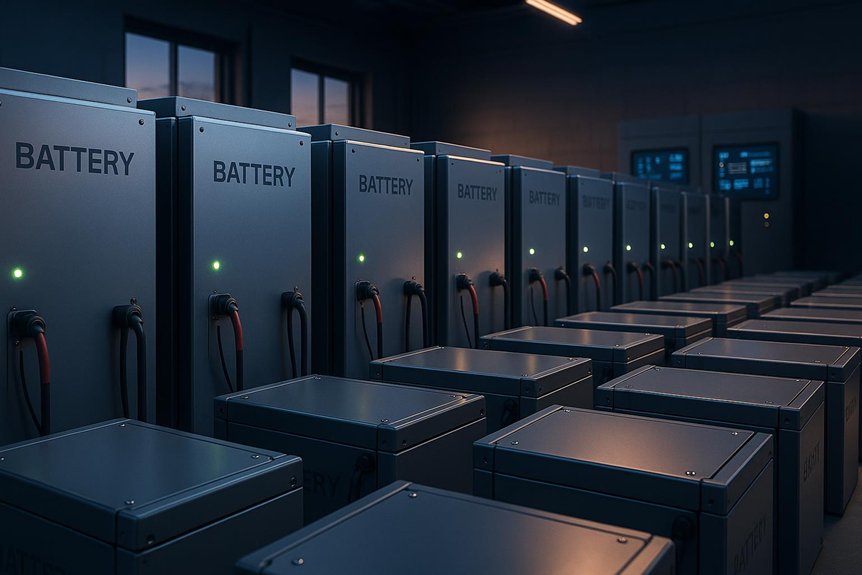
Should I add battery storage to my solar panels in 2025?
Battery storage systems capture excess electricity from solar panels during sunny days and release power back to your home during evenings or power cuts. These lithium-ion systems cost £4,000-£8,000 but can slash energy bills by storing cheap daytime solar power for expensive evening use, whilst providing backup electricity during grid outages.
The night my neighbour’s lights stayed on during the power cut
It was half past eight on a Tuesday evening in February when the power went out across our entire street. I was fumbling around for candles and cursing the timing – right in the middle of Coronation Street – when I noticed something odd.
Sarah’s house next door was still lit up like Christmas.
“How are your lights still on?” I called over the fence, genuinely baffled.
“Solar battery,” she grinned, appearing at her back door with a steaming mug of tea. “My panels charged the battery during the day, and now it’s keeping everything running. Want to come in for a brew while we wait for the power to come back?”
That’s when I realised battery storage wasn’t just about saving money – it was about never being caught in the dark again.
How do solar batteries actually store electricity?
I’d never really thought about what happens to electricity when you “store” it until Sarah’s engineer explained it during a routine service visit.
Battery storage systems convert electrical energy into chemical energy, a bit like charging your phone but on a massive scale. When your solar panels generate more electricity than you’re using, the battery management system redirects excess power into lithium-ion cells.
“Think of it like filling a water tank,” the engineer explained. “Solar panels pump electricity in during the day, and you can drain it out whenever you need it. The clever bit is the software that decides when to charge, when to discharge, and when to buy cheap electricity from the grid.”
Sarah’s 10kWh battery stores enough electricity to power her home for roughly 8-12 hours, depending on what’s switched on. The system automatically switches between solar panels, battery power, and mains electricity without her even noticing.
During sunny days, excess solar electricity charges the battery first, then any remaining surplus gets exported to the grid through the Smart Export Guarantee. On cloudy days or at night, the battery supplies power before drawing expensive electricity from the National Grid.
Which type of battery technology actually works best for UK homes?
After seeing Sarah’s setup work flawlessly for two years, I started researching different battery technologies for my own home.
Lithium-ion batteries dominate the UK market because they pack lots of energy into compact units. Sarah’s Tesla Powerwall 2 stores 13.5kWh in a unit smaller than a gas boiler. These systems last 10-15 years with warranties covering 4,000-6,000 charge cycles.
Lithium iron phosphate (LFP) batteries offer enhanced safety and longer lifespans. My friend David installed a GivEnergy system using LFP technology. “They don’t get as hot as standard lithium-ion,” he explained. “Plus they’re supposed to last 6,000+ cycles, which works out to about 15-20 years.”
Lead-acid batteries cost much less upfront but I quickly ruled them out. They only last 3-5 years, need regular maintenance, and lose efficiency in cold weather – not ideal for British garages.
Flow batteries sound fascinating but they’re mainly for industrial use. The systems are huge and expensive, though they can last 25+ years with minimal degradation.
Looking back, I probably should have focused more on total cost per kilowatt-hour over the battery’s lifetime rather than just upfront price. LFP batteries cost more initially but often work out cheaper because they last longer.
Do solar batteries actually save money on UK energy bills?
This was my biggest question after watching Sarah’s energy costs plummet. So I asked her to walk me through her actual bills.
Before battery storage: £45-£80 monthly electricity bills (she already had solar panels) After battery storage: £15-£35 monthly electricity bills Additional annual savings: £400-£600 from time-of-use optimization
“The real magic happens with Octopus Agile,” Sarah explained, showing me her energy app. “Electricity prices change every 30 minutes. My battery charges automatically when prices drop below 10p per kWh – sometimes it’s even negative and I get paid to charge!”
Her battery management system tracks electricity prices and weather forecasts 48 hours ahead. On sunny days, it prioritises solar charging. When rain is forecast, it pre-charges from cheap overnight grid electricity.
Typical annual savings with different battery sizes:
- 5kWh battery: £300-£500 savings
- 10kWh battery: £500-£800 savings
- 15kWh battery: £600-£1,000 savings
The payback period works out to 8-12 years for most UK installations. That’s longer than solar panels alone, but batteries provide backup power value that’s hard to quantify until you actually need it.
Peak electricity rates during winter evenings can hit 40-50p per kWh. Storing cheap 7p overnight electricity or free solar power and using it during these expensive periods creates substantial savings.
When does adding battery storage make financial sense?
Sarah’s decision to add batteries 18 months after her solar installation was driven by specific circumstances that I found quite revealing.
Battery storage makes sense if:
- Your solar panels regularly export electricity to the grid
- You’re home mainly in evenings when solar panels aren’t generating
- Your area experiences regular power cuts
- You can access time-of-use electricity tariffs
- Your electricity bills exceed £100 monthly
It probably doesn’t if:
- You use most electricity during sunny daytime hours
- Your main goal is just reducing bills (solar panels alone achieve this)
- You’re planning to move house within 8 years
- Your electricity usage is very low already
“I was exporting £30-40 worth of solar electricity monthly at rubbish export rates,” Sarah explained. “The battery lets me use that electricity myself instead of giving it away cheap and buying it back expensive.”
Her usage pattern shifted dramatically after working from home became permanent. Previously, most solar generation happened while the house was empty. Now the battery bridges the gap between peak solar production and evening electricity demand.
Battery storage works brilliantly with Economy 7 or Octopus Go tariffs that offer cheap overnight rates. You can charge from the grid at 7-10p per kWh and use stored electricity during 25-35p peak periods.
What size battery do you actually need for a UK home?
This took me weeks to figure out properly, mainly because everyone’s usage patterns are completely different.
Sarah installed a 10kWh battery to match her evening electricity consumption. “I tracked my usage for three months,” she said. “Between 4pm and midnight, we typically use 8-12kWh. The 10kWh battery covers that with a bit of headroom for higher-usage days.”
Sizing guidelines for different homes:
- Small household (1-2 people): 5-8kWh battery
- Average household (3-4 people): 8-12kWh battery
- Large household (5+ people): 12-15kWh battery
But usage patterns matter more than household size. My friend Mike lives alone but works from home with multiple computers running constantly. His 15kWh battery barely covers his daily consumption.
The trick is matching battery capacity to your evening/overnight electricity needs, not total daily consumption. Most UK homes use 60-70% of daily electricity between 4pm and 8am when solar panels generate little power.
“Start with a smaller battery and add more later if needed,” Sarah advised. “Battery prices keep falling, and most systems allow expansion. I might add another 5kWh unit next year.”
Oversizing batteries costs a fortune and reduces financial returns. Undersizing means missing opportunities to store cheap electricity or provide adequate backup power.
How long do solar batteries last and what happens when they die?
This was probably my biggest concern after hearing horror stories about expensive battery replacements.
Modern lithium-ion batteries degrade slowly – typically losing 2-3% capacity annually. Sarah’s two-year-old battery still holds 96% of original capacity according to her monitoring app. Most manufacturers warrant 70-80% capacity after 10 years.
“Even at 70% capacity, it’ll still provide useful backup power and bill savings,” Sarah pointed out. “Though I’ll probably upgrade to newer technology when the time comes.”
Expected battery lifespan by technology:
- Standard lithium-ion: 10-12 years
- Lithium iron phosphate (LFP): 12-15 years
- Lead-acid: 3-5 years (avoid these)
Replacement costs keep falling as technology improves. Sarah paid £7,000 for her 10kWh system in 2023. Similar capacity systems now cost £5,000-£6,000, and prices continue dropping.
Battery recycling has improved dramatically. Major manufacturers like Tesla and LG offer take-back programs that recover lithium, cobalt, and other valuable materials. Some companies even offer trade-in credits toward new batteries.
“The inverter and installation framework should last 20+ years,” Sarah’s installer explained. “When the battery needs replacing, you’re mainly swapping out the lithium-ion cells, not the entire system.”
Advanced battery management systems prevent overcharging and deep discharging that accelerate degradation. Sarah’s battery rarely charges above 95% or discharges below 10%, protecting the lithium-ion chemistry.
Is battery backup actually reliable during power cuts?
Sarah’s experience during that Tuesday evening power cut convinced me that backup capability alone justifies battery storage for many homes.
Modern battery systems provide seamless backup power through automatic transfer switches that activate within milliseconds of detecting grid failure. Essential circuits stay powered whilst non-essential loads get disconnected to preserve battery life.
“We didn’t even realise the power was out until we looked outside,” Sarah laughed. “The TV kept playing, the WiFi stayed connected, and the boiler carried on working. It was only when I tried making toast that I discovered my kitchen sockets were on the non-essential circuit.”
Typical backup power duration:
- Essential circuits only: 12-24 hours
- Whole house backup: 4-8 hours
- Refrigeration and lighting: 2-3 days
Battery backup proves invaluable during planned power cuts for infrastructure work. Sarah’s area had three scheduled outages last year for cable upgrades. Her battery powered critical loads throughout each 6-hour outage window.
Some systems can even black-start – powering solar panels and charging batteries entirely off-grid after extended outages. This provides genuine energy independence during natural disasters or grid failures.
The psychological benefit shouldn’t be underestimated. Knowing you have backup power reduces anxiety during storms and provides genuine peace of mind, especially for households with medical equipment or vulnerable residents.
What about safety – are lithium-ion batteries dangerous in homes?
This was my wife’s biggest concern after reading news stories about electric vehicle battery fires.
Modern residential battery systems include multiple safety layers that make thermal runaway (battery fires) extremely rare. Sarah’s installer walked us through the safety features during our consultation.
“Each battery cell has its own monitoring circuit,” he explained. “If any cell overheats or behaves abnormally, the battery management system isolates it immediately. There are also temperature sensors, smoke detectors, and automatic fire suppression systems.”
Key safety features in quality battery systems:
- Individual cell monitoring and isolation
- Thermal management with active cooling
- Automatic disconnect during fault conditions
- Fire-resistant housing and installation locations
- Regular firmware updates addressing safety issues
Proper installation matters enormously. Batteries should be mounted away from escape routes, in ventilated areas, with adequate clearance for service access. Sarah’s Powerwall is mounted in her garage with direct outside air circulation.
UK building regulations require battery installations to meet specific safety standards. MCS-certified installers must follow strict guidelines for electrical connections, mounting systems, and safety equipment.
The fire risk from properly installed residential battery systems is statistically lower than many common household appliances. However, choosing reputable manufacturers and certified installers remains crucial for safety.
How do you choose between different battery brands and installers?
After getting quotes from six different companies, I learned that installer quality matters more than brand names.
Major brands dominating the UK market:
- Tesla Powerwall: Premium pricing, excellent app integration
- GivEnergy: Good value, UK company with strong support
- LG Chem: Reliable technology, competitive pricing
- Pylontech: Budget option, basic functionality but proven
- SolarEdge: Integrates well with SolarEdge solar systems
Sarah chose Tesla mainly for the app and monitoring capabilities. “Being able to control everything from my phone was worth the extra cost,” she said. “Plus the warranty and support network seemed more established.”
Questions I learned to ask installers:
- How many battery systems have you installed locally?
- What’s included in your warranty beyond manufacturer coverage?
- Can you provide references from recent customers?
- How do you handle system monitoring and maintenance?
- What happens if there’s a fault at 2am on Sunday?
The cheapest quote I received turned out to be from a solar-only company with minimal battery experience. The most expensive came with luxury features like whole-house backup that I didn’t actually need.
Installation quality affects long-term reliability more than brand differences. Sarah’s installer returned three times in the first year for minor software updates and optimization tweaks at no extra charge.
Local installers often provide better ongoing support than national companies. They’re more likely to respond quickly to issues and understand local electrical infrastructure quirks.
Should you add batteries to existing solar panels or wait?
Sarah added batteries 18 months after her original solar installation, which turned out to be perfect timing.
“I wanted to understand my solar generation patterns first,” she explained. “The monitoring data showed I was exporting 60% of generated electricity. That made the business case for batteries really clear.”
Benefits of adding batteries to existing solar:
- You understand your generation and consumption patterns
- Battery technology improves and costs fall constantly
- Solar installation costs are already recovered
- Many batteries integrate easily with existing inverters
Benefits of installing solar and batteries together:
- Single installation disruption and scaffolding cost
- Optimized system design from the start
- Potential package deal savings
- Unified warranty and support
Battery-ready inverters make future expansion straightforward. Sarah’s solar inverter had battery connections already built in – adding the Powerwall required just connecting DC cables and updating software settings.
“If I was doing it again, I’d probably install a smaller battery initially and expand later,” Sarah reflected. “Battery prices have dropped 30% since my installation, and newer models offer better features.”
Waiting also lets you access improved technology. Batteries released in 2025 offer better safety features, longer warranties, and higher energy density compared to 2023 models.
The key is ensuring your electrical installation can accommodate future battery additions. This might require upgrading your consumer unit or adding dedicated circuits during initial solar installation.
What’s the realistic payback period for battery storage in 2025?
After crunching numbers on my own situation, I found payback periods vary dramatically based on electricity usage patterns and tariff choices.
Sarah’s system cost £7,000 and saves roughly £600 annually on electricity bills. That suggests a 12-year payback period, but the backup power value during outages is harder to quantify financially.
Factors affecting payback periods:
- Battery purchase price and installation costs
- Annual electricity bill savings from energy arbitrage
- Access to time-of-use tariffs with significant price spreads
- Value placed on backup power and energy independence
- Future electricity price rises and tariff changes
Battery prices continue falling whilst electricity prices keep rising. Systems installed in 2025 should achieve better payback periods than Sarah’s 2023 installation.
“Don’t forget about avoiding future grid connection charges,” Sarah pointed out. “Some areas are introducing peak demand charges that batteries help reduce. That adds to the financial benefits.”
Realistic payback expectations:
- Optimized installations with time-of-use tariffs: 8-10 years
- Standard installations with good usage patterns: 10-12 years
- Sub-optimal setups or low electricity consumption: 15+ years
The payback calculation improves if you value backup power capability. Commercial backup generators cost £3,000-£5,000 plus ongoing maintenance, making battery backup look more attractive financially.
After 10-12 years, you essentially get free electricity storage for the remaining battery life, plus potential revenue from grid services as these markets develop further.
Battery Storage Decision Framework
Install battery storage now if:
- Your solar panels export significant electricity monthly
- You experience regular power outages
- Evening electricity consumption exceeds 8kWh daily
- You can access time-of-use tariffs with large price spreads
- Backup power provides peace of mind worth the investment
Consider waiting if:
- Battery prices are falling faster than electricity prices rise
- Your solar system is less than 12 months old
- Major home renovations are planned within 3 years
- Your evening electricity usage is very low
- Budget constraints make current prices challenging
Technical specifications summary:
- Capacity sizing: 1-1.5kWh per kW of solar panels installed
- Installation time: 4-8 hours for retrofit systems
- Warranty expectations: 10+ years or 4,000+ cycles minimum
- Backup power: Essential circuits only for longer duration
- Monitoring: Smartphone apps with real-time usage data
Battery storage transforms solar panels from a simple bill-reduction measure into a comprehensive energy independence solution. The technology has matured beautifully, costs continue falling, and backup power provides genuine peace of mind during an increasingly unpredictable energy landscape.
For me, watching Sarah’s lights stay on during that power cut was worth more than any financial calculation.