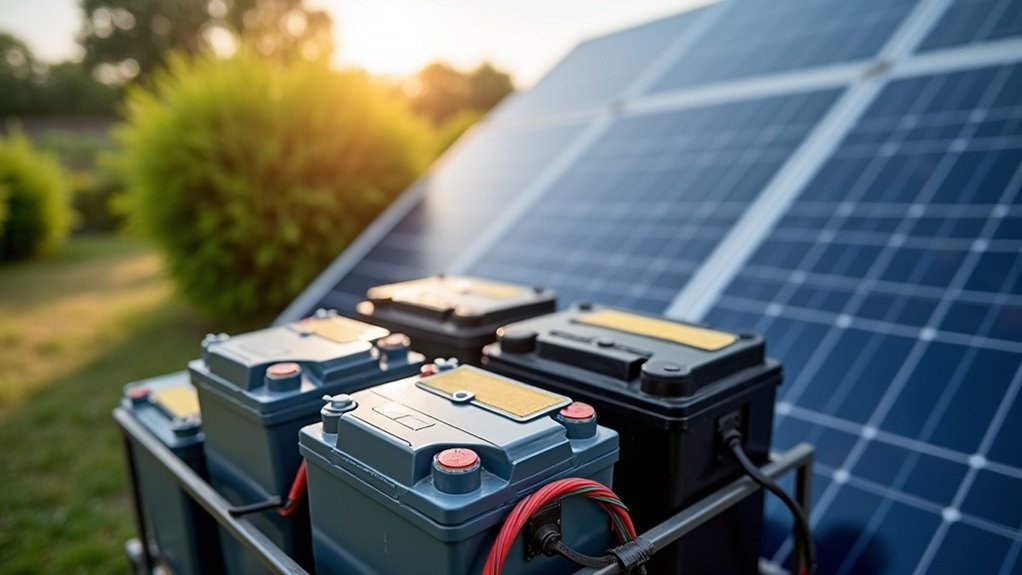
For a 400-watt solar system, you typically need at least one 150Ah battery to store the energy efficiently, though a 200Ah lithium battery is preferred for better performance and longer life. This capacity supports the roughly 2,400 watt-hours generated daily under ideal sunlight, translating to about 200Ah. Real-world conditions usually yield 100–150Ah daily output, making a single larger lithium battery ideal for storage and simplicity. Exploring these details further will clarify your battery choices.
Understanding Battery Capacity Requirements for a 400-Watt Solar System
When evaluating battery capacity requirements for a 400-watt solar system, you need to take into account both the voltage and the daily energy output to guarantee reliable storage and usage. Typically operating at 12 volts, such a system demands a battery capacity of at least 150 ampere-hours (Ah) to function effectively. However, a 200Ah lithium battery is ideal, offering improved efficiency and longevity. Real-world conditions often produce between 100 and 150Ah daily, so opting for a single larger battery rather than multiple smaller ones enhances space utilization and cost-effectiveness. Additionally, a 200Ah battery usually requires 4 to 6 hours of charging under favorable solar conditions, necessitating around 1,200 watts of system output to reach full charge. This setup guarantees consistent energy availability for your needs. For typical household use, batteries with capacities between 5–15kWh are considered optimal, providing a good balance of storage and cost efficiency for systems like this typical capacity.
Calculating Daily Energy Production and Storage Needs
Although solar energy production can fluctuate based on environmental conditions, a 400-watt solar system typically generates around 2,400 watt-hours per day under six hours of direct sunlight, which equates to about 200 ampere-hours at a 12-volt system voltage. To effectively calculate your storage needs, consider these factors:
- Divide daily watt-hours by system voltage to find ampere-hours (2,400 ÷ 12 = 200Ah).
- Expect real-world output to range between 100-150Ah due to environmental variables.
- A minimum battery capacity of 150Ah is recommended for adequate storage.
- Charging a 200Ah battery requires 4-6 hours under ideal conditions.
- Opting for a 200Ah lithium battery enhances efficiency and reliability.
These calculations help you determine the battery capacity needed to store your solar energy effectively. Keep in mind that lithium-ion batteries are often preferred for their long lifespan and high energy density, making them ideal for such applications.
Comparing Battery Types and Sizes for Optimal Performance
Since selecting the right battery type and size directly influences your solar system’s efficiency and longevity, it’s crucial to compare options carefully. For a 400-watt solar system operating at 12 volts, you need a battery capacity of around 200Ah to store sufficient energy, accounting for real-world usage. Lithium batteries stand out because they offer longer lifespans, higher efficiency, and deeper discharge capabilities compared to lead-acid alternatives. While the minimum capacity is 150Ah, opting for a 200Ah lithium battery provides peak performance, balancing capacity, space, and cost. Using a single 200Ah lithium battery simplifies installation and maintenance, ensuring your system can reliably deliver 160-200 ampere hours daily under ideal conditions. This approach maximizes energy storage without unnecessary complexity or expense. Lithium iron phosphate (LFP) batteries, in particular, are favored for their high stability and long cycle life, making them an excellent choice for solar energy storage systems.
Impact of Usage Patterns on Battery Quantity and Configuration
Because your daily energy consumption fluctuates, you need to carefully assess how those patterns influence the number and arrangement of batteries in your 400-watt solar setup. Your typical usage dictates the total amp hours required, with a daily wattage estimate—like 2,400 watts from six hours of sunlight—guiding battery capacity decisions. If your appliances draw more power during peak times, you might need additional batteries to maintain a stable supply. Real-world conditions often yield 100–150 amp hours daily, impacting battery quantity based on actual versus theoretical needs. Generally, a single 200Ah lithium battery offers efficient storage and simpler configuration compared to multiple smaller batteries.
- Calculate daily watt-hour consumption accurately
- Match battery amp-hour capacity to usage
- Account for peak-hour energy spikes
- Consider real-world amp-hour availability
- Prefer single large batteries for efficiency and space
Tips for Efficient Battery Maintenance and Longevity
Proper maintenance plays a significant role in maximizing the lifespan and efficiency of your solar battery system, especially when managing a 400-watt setup. You should keep the battery charge between 20% and 80% to avoid deep discharges that can shorten battery life. Regularly inspect lead-acid batteries to maintain water levels by topping them with distilled water, which prevents sulfation. Employ a solar charge controller to regulate charging rates and prevent overcharging that damages battery capacity. Routinely check battery terminals and connections for corrosion, cleaning them to guarantee efficient power transfer and avoid voltage drops. Additionally, store your batteries in a cool, dry environment, as temperature extremes accelerate degradation and impair performance, ultimately reducing the overall longevity of your solar energy storage system.