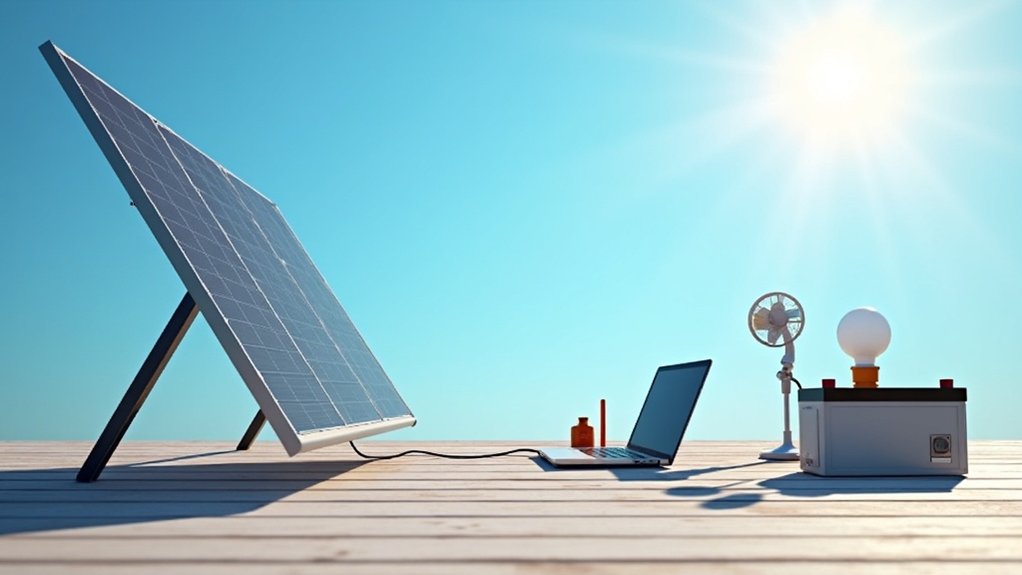
A 300 watt solar panel can reliably power small household appliances like LED lights, ceiling fans, laptops, and a 50-inch LED TV for about 4 to 5 hours daily, generating roughly 1.5 kilowatt-hours under ideal sunlight. It handles low-demand devices and charges smartphones within hours but cannot support heavy appliances such as heaters or washing machines due to limited continuous output. Understanding its efficiency and constraints helps optimize your energy use and economic benefits, with more insights available.
Understanding the Power Output of a 300 Watt Solar Panel
A typical 300-watt solar panel consists of approximately 60 individual solar cells, each producing around 0.5 to 0.6 volts, which collectively convert sunlight into electrical energy. Under ideal sunlight conditions, this panel can generate between 1.2 and 1.8 kilowatt-hours (kWh) per day, depending on your location and exposure. This energy output can power smaller devices such as lights, phone chargers, and laptops, but it might not sustain larger appliances continuously. To use this electricity in your home, you’ll need an appropriate inverter system that converts the direct current (DC) produced by the panel into alternating current (AC), which most household appliances require. Utilizing a 300-watt solar panel reduces your dependence on grid electricity, potentially lowering your electricity bills and minimizing your carbon footprint. The panel’s efficiency and power output can be affected by factors such as roof orientation and shading from nearby objects.
Common Appliances Compatible With a 300 Watt Solar Panel
Several common household and portable appliances fall within the operational capacity of a 300-watt solar panel, allowing you to power essential devices without relying on traditional electricity sources. You can run ceiling fans, LED lights, and laptops efficiently, which suits off-grid living and camping needs. Additionally, a 300-watt panel can operate a small fridge consuming between 50 to 100 watts for several hours, maintaining food and beverage cooling. It supports charging smartphones and tablets simultaneously, with an average charging time of 2 to 3 hours per device. You can also power a 50-inch LED TV for about 4 to 5 hours, depending on usage. Kitchen appliances like rice cookers and coffee makers are compatible if their combined wattage does not exceed 300 watts at any given moment.
Limitations and Power Constraints of 300 Watt Solar Panels
Although 300-watt solar panels offer a practical solution for powering small appliances and charging devices, their limitations become apparent when you consider the energy demands of larger household equipment. These panels can only supply up to 300 watts of continuous power, which restricts their use to low-wattage devices like LED lights and laptops. High-demand appliances such as electric heaters or washing machines exceed this capacity and cannot be powered effectively. Additionally, their output depends heavily on sunlight conditions; cloudy weather or nighttime reduces energy generation considerably. Typically, you’ll get about 240 to 270 watt-hours per day, less than the rated 300 watts. While pairing with battery storage helps extend usage, continuous operation of larger devices remains unfeasible due to these inherent power constraints. Using a solar battery can help store surplus energy generated during peak sunlight hours for use when the panel output is low or demand is higher.
Maximizing Efficiency and Usage of 300 Watt Solar Panels
Understanding the limitations of 300-watt solar panels highlights the importance of enhancing their performance to meet your energy needs effectively. To maximize efficiency, position your panel at an angle of 30-45 degrees, adjusting for your geographic location and season to capture ideal sunlight. Using high-efficiency solar cells can boost electricity generation, enabling you to power multiple small devices simultaneously. Regularly clean the panel to remove dirt, snow, or debris that obstructs sunlight and reduces output. When paired with a compatible 300-watt solar generator, the panel can reliably run appliances like ceiling fans, lights, phone chargers, and small refrigerators for several hours daily. By carefully managing installation and maintenance, you guarantee that your 300-watt panel operates at peak capacity, providing consistent, dependable power within its design constraints. For optimal results, consider consulting reputable installers who can tailor the installation to your energy usage and property specifics.
Environmental and Economic Benefits of Using 300 Watt Solar Panels
When you install a 300-watt solar panel, you not only reduce your dependence on the electrical grid but also lower your household energy expenses by generating clean, renewable power. Each panel can offset 300 to 450 kilograms of carbon dioxide emissions annually, greatly contributing to environmental sustainability and improved air quality. Economically, the initial installation cost qualifies for a 26% Federal Investment Tax Credit, enhancing affordability. Over its lifespan of 25 years or more, the panel provides ongoing energy without fuel costs, resulting in long-term savings. Additionally, homes equipped with solar panels often see increased property values, appealing to buyers interested in sustainability and reduced energy bills. Consequently, using 300-watt solar panels offers both environmental benefits and economic advantages. Furthermore, surplus electricity generated can be sold back to the grid under the Smart Export Guarantee, providing an additional income stream.