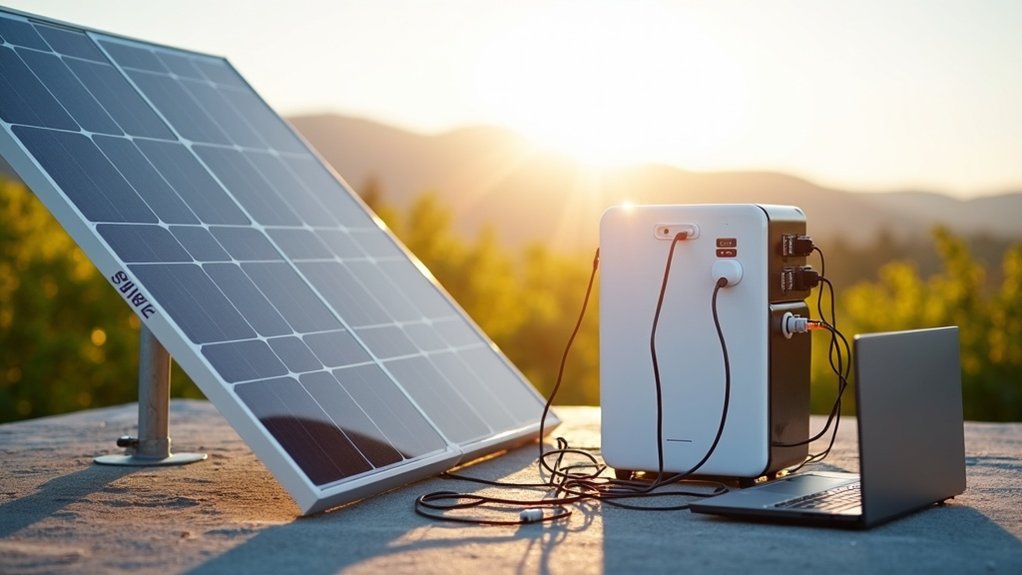
A 400W solar panel typically generates about 1.2 to 1.5 kWh daily, sufficient to power essential home devices like refrigerators, around 40 LED bulbs, laptops, and small microwaves briefly under ideal sunlight. Its performance depends on factors such as location, panel angle, and shading, which influence output variability. You can optimize usage by aligning the panel correctly and pairing it with energy-efficient appliances. Understanding these aspects will clarify how to maximize your solar setup efficiently.
Typical Energy Output of a 400W Solar Panel
A 400-watt solar panel typically produces between 1.2 and 1.5 kilowatt-hours (kWh) of electricity daily, though this output varies considerably based on geographic location and sunlight exposure. For example, in the North East, you can expect about 1.1 kWh per day, while in the South, production may reach up to 1.4 kWh daily. Under ideal conditions, the panel delivers roughly 300 watts of real-world output due to factors like shading and temperature fluctuations. This energy generation is enough to power certain household devices for several hours, enabling you to reduce your electricity costs effectively. Understanding these output variations helps you gauge what a 400W solar panel can realistically contribute to your energy needs.
Household Appliances Compatible With a 400W Solar Panel
Understanding the range of household appliances compatible with a 400-watt solar panel requires examining both power consumption and daily energy output. This panel typically generates between 1.2 kWh and 1.5 kWh daily, enough to power devices like a refrigerator or several hours of TV use. You can run around 40 LED bulbs, each consuming about 10 watts, or a laptop drawing 50 to 100 watts. Small microwaves, which use roughly 600 watts briefly, are also feasible. Additionally, a small air conditioner operating between 600 and 1,200 watts can run for a few hours, depending on usage. When paired with battery storage, essential equipment such as medical devices, communication tools, and small kitchen appliances can be reliably powered during outages.
Factors Affecting Solar Panel Performance
Though a 400-watt solar panel is rated for a certain power output, its actual performance depends on multiple factors, such as geographic location, seasonal sunlight variability, and panel positioning. For example, daily energy production can range from 1.1 kWh in the Northeast to 1.4 kWh in the South, reflecting regional differences in sunlight. Seasonal changes and weather conditions also cause fluctuations, reducing output compared to the rated capacity. Additionally, the angle and orientation of your panels are essential; panels that capture maximum sunlight perform considerably better. Shading from trees or buildings can drastically lower electricity generation. Finally, the efficiency of the solar cells, usually between 15% and 22% for quality panels, determines how effectively sunlight converts into usable power, directly impacting overall performance. You can receive up to 4 free quotes from approved local installers to find the best options for your specific location and needs.
Maximizing the Use of a 400W Solar Panel
How can you get the most out of a 400W solar panel in your daily energy setup? First, position the panel to receive maximum sunlight exposure, ideally angling it according to your local latitude to enhance energy absorption throughout the day. You can run energy-efficient appliances like a television, refrigerator, or LED lights, generating between 1.2 kWh and 1.5 kWh daily. In prime sunlight regions, it even powers small air conditioners for limited hours or charges multiple devices simultaneously. Pairing the panel with battery storage enhances reliability, allowing you to maintain critical systems like medical equipment during outages. For larger energy demands, combining multiple panels—typically 15 to 30—enables operation of substantial appliances such as electric water heaters or home heating, depending on your consumption needs. Adding a solar battery to store unused electricity can maximize your energy use and provide power when the sun isn’t shining.