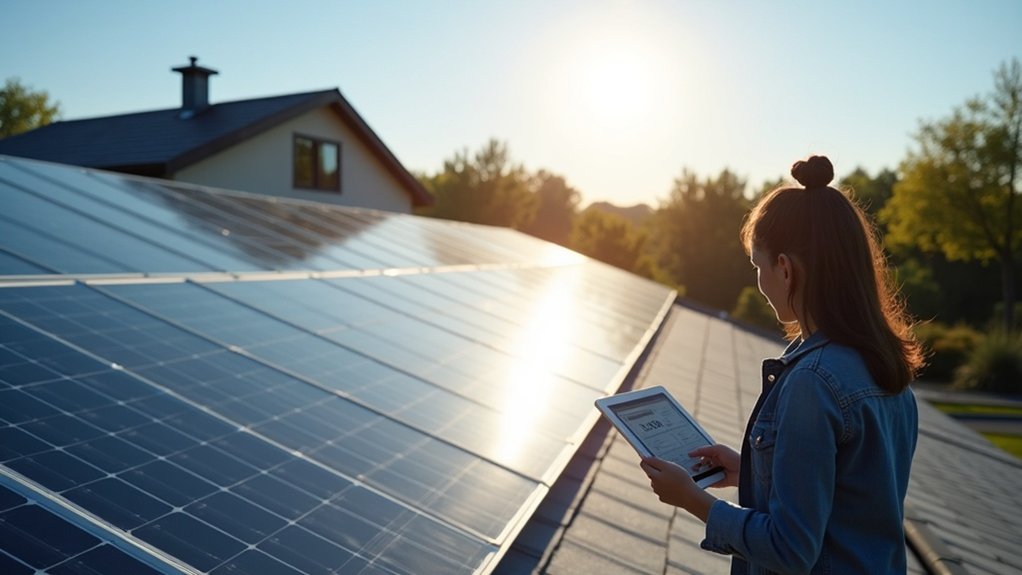
To determine how many solar panels you need for self-sufficiency, calculate your annual electricity use first—typically around 2,700 kWh for an average three-bedroom home. Each 350-watt panel produces about 265 kWh yearly, but factors like your location’s sunlight, roof orientation, and panel efficiency (20%-24%) greatly affect the total number required. South-facing roofs and minimal shading improve output, reducing panels needed. Understanding these elements clarifies your solar setup; exploring panel efficiency and placement further enhances your planning.
Calculating Your Home’s Annual Electricity Consumption
To calculate your home’s annual electricity consumption, start by reviewing your energy bills to determine the total kilowatt-hours (kWh) used over the past year; for example, a typical three-bedroom house consumes approximately 2,700 kWh annually. If you don’t have access to your bills, contact your energy supplier to obtain this information. Knowing your annual usage is critical because it allows you to estimate the number of solar panels needed for self-sufficiency. For instance, an average 350-watt solar panel produces about 265 kWh yearly. By dividing your total yearly consumption by the panel’s output, you can calculate how many panels you’ll require. Larger homes tend to consume more electricity, so their panel requirements will naturally increase accordingly. Additionally, considering solar panel efficiency can help optimize the number of panels needed based on the energy your system can realistically generate.
Factors Affecting the Number of Solar Panels Needed
Although calculating your home’s annual electricity consumption provides a baseline, several key factors influence the actual number of solar panels you’ll need for self-sufficiency. The size of your home and the number of occupants directly affect energy use; for example, a typical three-bedroom house consumes about 2,700 kWh annually, often requiring around 10 panels. Geographic location is essential since solar panels generate more electricity in sunnier regions, meaning you might need additional panels in areas with less sunlight. Roof orientation and condition also matter; south-facing, well-maintained roofs optimize panel performance, while complex or damaged roofs can limit installation options. Additionally, panel efficiency plays a significant role—higher efficiency models, reaching up to 24%, produce more energy per panel, reducing the total number needed to meet your consumption. Seasonal sunlight variations also affect energy production, especially during winter months when solar generation tends to be lower due to reduced daylight hours and sun intensity, which is an important consideration for overall solar panel efficiency.
Optimizing Solar Panel Efficiency and Placement
When optimizing solar panel efficiency and placement, understanding how panel efficiency and roof characteristics interact is crucial for maximizing energy production. Panels with efficiencies around 20% to 24% affect the total number you’ll need; higher efficiency means fewer panels. Roof orientation plays a critical role, with south-facing roofs producing the most electricity, while east or west-facing roofs yield 20% to 30% less. Complex roof designs might limit panel placement, reducing potential output. Additionally, shading from trees, chimneys, or nearby buildings can considerably impair performance, so you must consider these factors carefully. Using more efficient panels in limited roof space can enhance your system’s capacity, enabling greater self-sufficiency despite spatial constraints. Balancing these elements guarantees you optimize energy generation effectively. Choosing monocrystalline solar panels can be particularly beneficial due to their high efficiency and better performance in limited spaces.