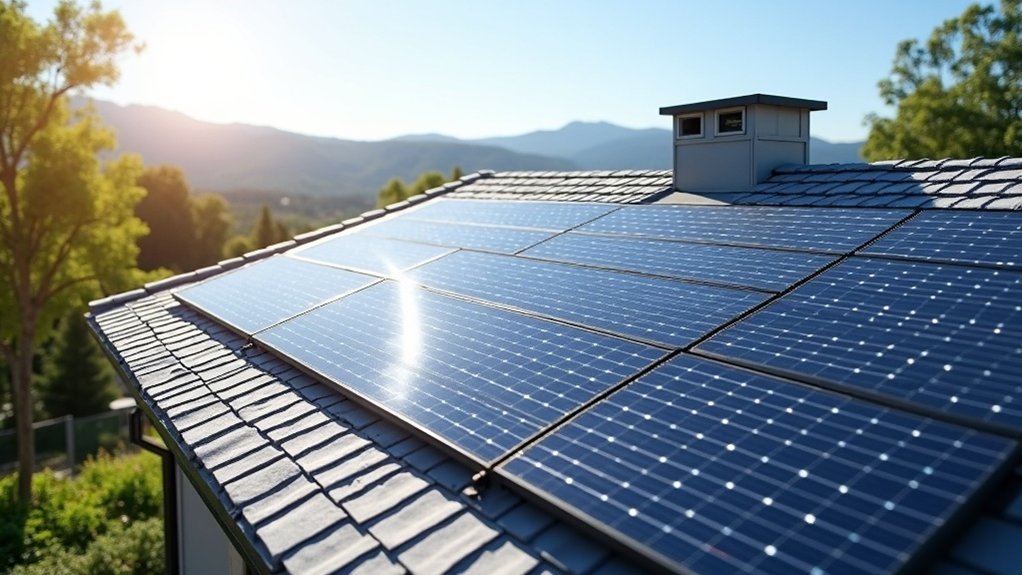
You typically need about 14 solar panels to power a four-bedroom house, but this depends on your exact electricity usage, roof orientation, and location. Larger households consume more energy, so evaluating your annual kilowatt-hour usage is essential. Sun exposure and panel efficiency also influence the total number required. South-facing roofs in sunnier regions may need fewer panels. Understanding these factors helps you estimate system size accurately, and deeper analysis reveals how to optimize your solar investment.
Estimating Solar Panel Requirements Based on Household Size and Energy Use
Estimating the number of solar panels needed for a four-bedroom house involves analyzing both household size and energy consumption patterns, as these factors directly impact your total electricity demand. Typically, a four-bedroom home requires around 14 solar panels to sufficiently cover its energy needs. However, since these households often consume more electricity annually than average, you might need additional panels. Solar panels generally cover about 49% of a household’s yearly electricity use, indicating that relying solely on a standard number might fall short. While estimating, consider that panel efficiency and geographic location affect output but won’t be discussed here. Focusing strictly on household size and consumption, you’ll find that analyzing your specific energy usage is essential to determine an accurate number of panels for your home. For those considering installation, consulting with MCS-certified installers ensures proper system sizing and compliance with regulations.
Key Factors Affecting the Number of Solar Panels Needed
Several factors influence how many solar panels you’ll need for your four-bedroom house beyond just household size and energy use. Your home’s annual electricity consumption plays a significant role since larger households generally consume more power, requiring more panels. Geographic location matters too; if you live in a sunny region, you might need fewer panels compared to areas with less sunlight. Roof orientation also affects panel efficiency—south-facing roofs capture the most solar energy, while east or west-facing roofs might demand additional panels to compensate for decreased output. Finally, the efficiency of the solar panels themselves is essential. Higher efficiency panels generate more electricity per unit, potentially reducing the total number needed. Considering these factors helps tailor your solar setup to your specific circumstances. Additionally, solar panel prices in the UK have decreased over 60% since 2010, making installation more affordable and accessible for homeowners looking to invest in solar panel installation.
Calculating Your Solar Panel Needs for Optimal Energy Coverage
How do you determine the exact number of solar panels needed to cover your four-bedroom house’s energy consumption? Start by evaluating your annual electricity usage in kilowatt-hours (kWh). For a typical four-bedroom home, this figure is higher than the average 2,700 kWh of a three-bedroom, often requiring about 14 solar panels. Next, divide your total yearly consumption by the average annual output of one solar panel, approximately 265 kWh. Keep in mind, the efficiency of your chosen panels influences this number; higher efficiency means fewer panels. Additionally, your geographic location and roof orientation affect energy production, potentially adjusting your panel count. By carefully calculating these factors, you guarantee ideal energy coverage tailored specifically to your household’s needs. It is also important to consider roof pitch and shading as these significantly impact the efficiency of your solar panel system.