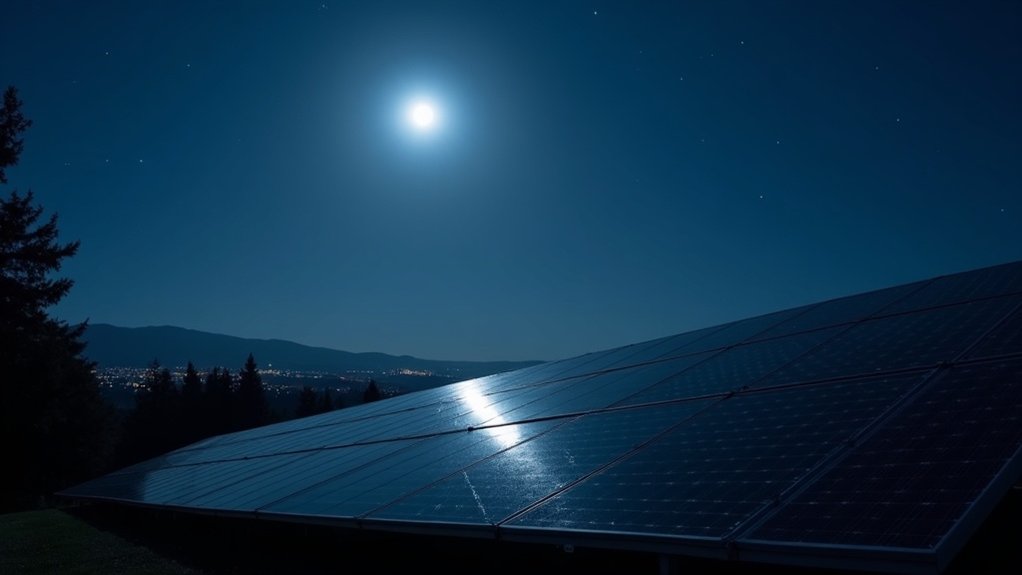
You can’t generate electricity with solar panels at night since they rely on sunlight to function, producing no usable power after sunset. While panels enter a sleep mode in darkness, you can still harness solar energy by storing surplus power in batteries during the day or using net metering to send excess energy back to the grid. These strategies guarantee reliable electricity when sunlight isn’t available, and understanding them is key to managing nighttime power effectively.
Understanding How Solar Panels Generate Electricity
Although solar panels have become a popular renewable energy source, understanding how they generate electricity requires examining their core components and processes. You’ll find that solar panels convert sunlight into direct current (DC) electricity using photovoltaic (PV) cells embedded within the panel. This DC electricity isn’t immediately usable in most homes, so it’s sent to an inverter, which transforms it into alternating current (AC) electricity compatible with household appliances. Solar panels work best under direct sunlight, reaching peak efficiency during midday when sunlight intensity is highest. On cloudy days, their energy output drops considerably, sometimes to just 10-25% of usual capacity, depending on cloud density. This reliance on sunlight is fundamental to their operation, affecting how and when they can supply electricity effectively. Modern PV panels convert over 22% of sunlight into electricity, demonstrating significant advances in solar panel efficiency.
The Impact of Darkness on Solar Panel Performance
Since solar panels rely entirely on sunlight to generate electricity, they become inactive after sunset, producing no usable energy during nighttime hours. In darkness, solar panels cannot convert energy and effectively enter a sleep mode, halting power generation until sunlight returns. Although minimal energy might be captured from artificial light sources at night, this output is negligible and insufficient for household demands. Consequently, your home must depend on alternative power sources during these periods, such as grid electricity or battery storage systems. Solar battery storage stores excess energy generated during daylight, allowing you to maintain a continuous power supply when solar panels are inactive. Understanding this limitation highlights the critical role of energy storage and backup systems in ensuring consistent electricity availability despite the absence of sunlight. Installing a solar battery can maximize your use of solar energy by storing surplus power generated during the day for use at night or during outages.
Solar Panel Efficiency During Cloudy Days
While solar panels rely on direct sunlight for peak performance, they can still generate electricity on cloudy days by capturing diffused sunlight, though their efficiency considerably decreases. You should expect output to drop to about 10-25% of normal levels, depending on cloud density. This reduction occurs because less sunlight reaches the solar cells. Even in overcast conditions, panels continue producing some energy, supporting usage in cities with frequent cloud cover like Seattle. Temperature also affects efficiency, with performance declining when panels exceed 77°F (25°C).
| Condition | Efficiency Range | Impact Reason |
|---|---|---|
| Clear sunlight | 100% | Direct sunlight |
| Light cloud cover | 25-50% | Partial sunlight blocking |
| Heavy cloud cover | 10-25% | Diffused sunlight only |
Solutions for Nighttime Power With Solar Energy
Because solar panels cannot produce electricity without sunlight, you need to implement alternative strategies to maintain power during nighttime hours. One effective approach involves integrating solar battery storage systems, which store surplus energy generated during the day for use when the sun isn’t shining. Another method is net metering, enabling you to send extra daytime energy back to the grid in exchange for credits, which can offset your nighttime consumption costs. Combining these strategies optimizes your energy management and guarantees continuous power availability.
Consider these solutions for nighttime solar power:
- Install solar batteries to store excess daytime energy for after dark
- Use net metering to earn credits by supplying surplus energy to the grid
- Coordinate battery storage with net metering to maximize power reliability and cost efficiency
Battery storage technologies, such as lithium-ion batteries, offer high efficiency and long cycle life, making them ideal for storing solar energy for nighttime use.
Benefits of Battery Storage and Net Metering Systems
Integrating battery storage and net metering systems offers tangible benefits that enhance the functionality and cost-effectiveness of solar energy setups. Battery storage lets you save surplus solar energy produced during the day, ensuring you have a reliable power supply at night when panels aren’t generating electricity. This reduces your dependence on the grid and provides greater energy independence. Meanwhile, net metering enables you to send excess energy back to the utility grid, earning credits that offset electricity costs incurred after sunset. By combining these systems, you can balance energy production and consumption more effectively, often lowering your overall utility bills. Together, battery storage and net metering improve the economic viability of solar installations, making solar power a more attractive and financially sound investment for homeowners. Additionally, participants in the Smart Export Guarantee scheme can receive payments for surplus electricity exported to the grid, further enhancing the financial benefits of solar energy systems.