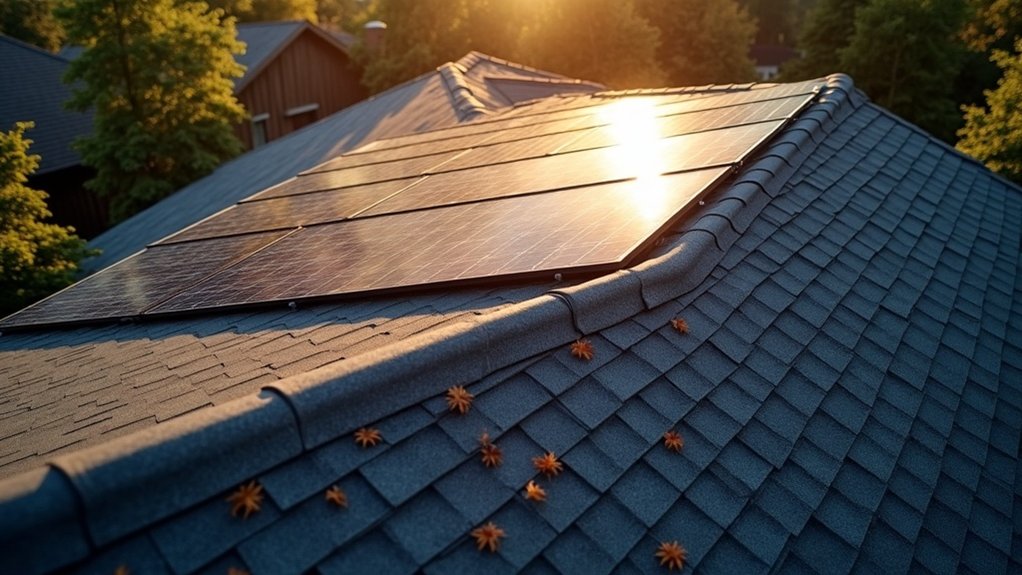
You can estimate how many solar panels fit on your roof by first measuring its usable area in meters, excluding obstructions like chimneys or vents, then multiplying length by width. Deduct 10-20% for airflow and maintenance space, and divide the remaining area by about 1.7 square meters—the size of a standard panel. This helps determine panel capacity and potential energy output based on wattage. Understanding these calculations, along with placement factors, offers clearer insights into your system’s design.
Measuring Your Roof for Solar Panel Installation
To accurately measure your roof for solar panel installation, start by determining the length and width of the usable area in meters, carefully excluding any obstructions such as chimneys, vents, or skylights that would reduce available space. Multiply these dimensions to find the total usable roof area, then reduce this figure by 10-20% to accommodate necessary airflow and maintenance access. Since each standard solar panel occupies about 1.7 square meters, divide your adjusted usable area by 1.7 to estimate the number of panels that can fit. Additionally, consider your roof’s orientation and tilt; south-facing roofs angled between 30 and 40 degrees generally maximize solar exposure. Finally, verify your measurements and plans comply with local building codes and regulations, which may restrict panel placement or installation methods.
Calculating Solar Panel Capacity and Energy Output
How do you determine the capacity and energy output of your solar panel system once you’ve established how many panels can fit on your roof? Start by multiplying the total number of panels by their wattage rating; for example, ten 400W panels yield a maximum output of 4,000W or 4 kWh per hour under ideal conditions. Remember to factor in the usable roof area after reducing 10-20% for obstructions like vents or chimneys. Additionally, consider the roof’s tilt and orientation—south-facing roofs angled between 30 and 40 degrees optimize solar exposure, enhancing energy production efficiency. This methodical calculation helps you estimate your system’s potential capacity and output accurately, ensuring it meets your energy needs while making the most of your available roof space. For accurate installation and compliance, it is essential to work with reliable installers who provide detailed quotes and architectural plans tailored to your property.
Tools to Estimate Solar Panel Fit and Performance
Which tools can provide the most accurate estimates for fitting solar panels on your roof and predicting their performance? Solar panel calculators, such as EvoEnergy’s Solar Panel Calculator, let you input roof dimensions, shading, and energy consumption to generate precise estimates. You should also calculate your total usable roof area and divide by the typical panel size of 1.7m², remembering to deduct 10-20% for obstructions and spacing. Additionally, many online tools offer insights into local regulations and incentives, affecting installation feasibility. To summarize, effective tools include:
- Solar panel calculators for customized fit and output projections
- Roof area measurement combined with panel size calculations
- Online platforms providing regulatory and financial guidance
Using these tools helps you make informed decisions before consulting solar professionals for tailored installation plans.
Key Factors Influencing Solar Panel Placement
Accurately measuring your roof’s usable area involves more than just length and width; you must account for obstructions like chimneys and vents that reduce available space for panels. In addition, deducting 10-20% of this area guarantees adequate spacing and airflow, which are essential for maintenance and panel efficiency. Roof orientation plays a critical role; south-facing roofs generally capture the most sunlight, improving energy output. The tilt angle is equally important, with a preferred range between 30 to 40 degrees to maximize solar exposure year-round. Moreover, you need to review local building codes and regulations, as they can restrict roof-mounted installations, limiting where and how panels can be placed. Considering these factors thoroughly will help you determine the realistic number of solar panels your roof can accommodate. It is also important to consider the roof pitch because an ideal angle enhances the efficiency of solar energy capture.
Strategies to Maximize Solar Energy Generation
When aiming to maximize solar energy generation, you’ll want to optimize several key factors beyond just panel quantity. Positioning your panels on a south-facing roof with a tilt angle between 30 and 40 degrees guarantees they capture the most sunlight throughout the day. Additionally, using high-efficiency panels can greatly increase energy output in limited spaces. Beyond panel selection and placement, consider energy storage solutions and shading prevention to boost overall performance. Key strategies include:
- Installing a battery storage system to store excess energy for use during low sunlight periods.
- Designing a custom panel layout that minimizes shading from roof obstructions like chimneys and vents.
- Exploring ground-mounted systems if roof space restricts the number of panels you can install.
These approaches collectively enhance your system’s energy generation efficiency. Incorporating a solar battery can maximize the utilization of generated electricity by storing surplus energy for use during non-sunny periods.