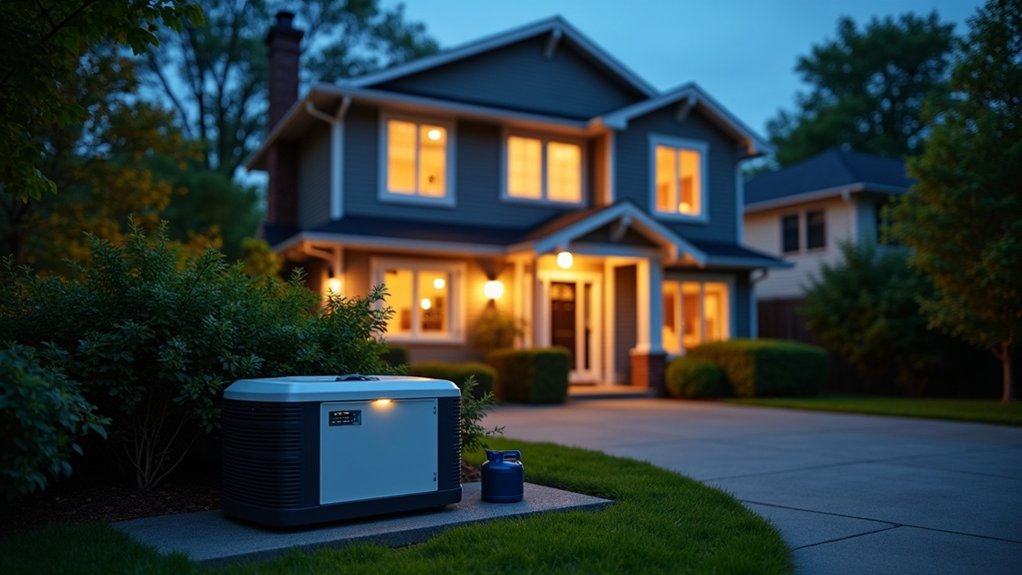
You’ll need a generator rated between 7 kW and 25 kW to run your house reliably, depending on the sum of your essential appliances’ running and starting wattage. Smaller portable units under 7 kW suit limited needs, while whole-home generators from 16 kW to 24 kW cover typical household demands, including heating, cooling, and kitchen appliances. Frequent outages and higher power use require larger capacities, ensuring safety and comfort. Further insights explain how to tailor generator size precisely to your home’s needs.
Calculating Your Home’s Total Power Requirements
When calculating your home’s total power requirements, you need to start by listing all essential appliances along with their wattage ratings, including refrigerators, heating and cooling systems, and electronic devices. You must account for both running and starting watts, especially for motorized appliances, since starting watts can be two to three times higher than running watts. For example, a refrigerator may run on 600 watts but require up to 2,000 watts at startup, so overlooking these spikes can lead to underestimating your power needs. Summing these values gives you a clearer picture of your total load. Remember to take into account peak usage periods and potential future electrical demands, which guarantees your system can handle variations without overloading during outages or high consumption times.
Choosing the Right Generator Size for Your Household
How do you determine the appropriate generator size to meet your household’s power demands? Start by evaluating the total wattage of essential appliances, which can range from about 7kW for basic needs to over 25kW for larger homes with high electrical loads. Portable generators under 7kW suit limited use, while models between 11kW and 15kW handle essentials plus air conditioning, fitting moderate power requirements. For more thorough coverage, whole-home generators typically range from 16kW to 24kW, supporting average-sized homes through extended outages. Additionally, consider how often and how long outages occur in your area; frequent, prolonged outages may justify investing in a larger, permanent generator rather than a smaller, portable one. Proper sizing guarantees efficiency, reliability, and protection for your property during power interruptions.
Benefits of Investing in a Whole-Home Generator
Although investing in a whole-home generator requires a significant upfront cost, it delivers extensive power coverage that safeguards essential household systems such as heating, cooling, and refrigeration during outages, thereby preventing food spoilage and maintaining indoor comfort. Beyond continuous power supply, these generators can enhance your property’s value and appeal, especially in regions prone to outages or severe weather. They also protect vulnerable areas like basements from flooding in high groundwater zones, reducing potential water damage and related insurance claims. Additionally, installing a whole-home generator may lower your insurance premiums by diminishing outage-related risks. Ultimately, this investment provides you with reliable power continuity and peace of mind, enabling your household to sustain normal routines during extended blackouts without disruption.