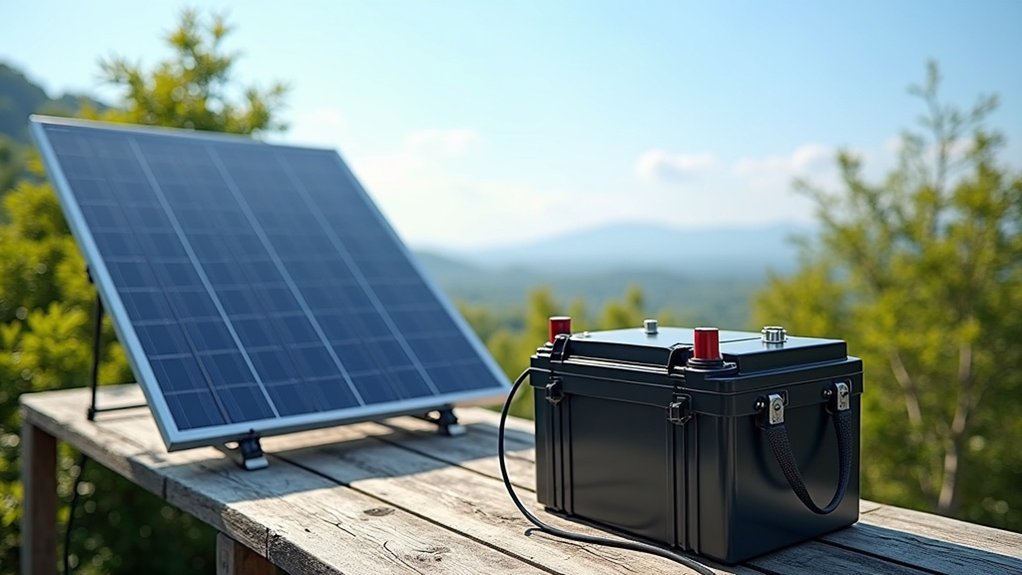
If you use a 200-watt solar panel to charge a 100Ah, 12-volt battery, expect it to take about 1.5 to 2 days under average sunlight. The battery stores roughly 1200Wh, and the panel produces around 700 to 800Wh daily after accounting for efficiency losses. A solar charge controller manages charging to protect the battery and optimize power flow. Understanding these factors helps clarify charging duration and system efficiency considerations ahead.
Understanding Battery Capacity and Solar Panel Output
Although a 100Ah battery at 12 volts stores 1200 watt-hours (Wh) of energy, fully charging it requires accounting for factors beyond its nominal capacity. A 200W solar panel can generate about 200Wh per hour under ideal conditions, leading to roughly 1000Wh in a typical 5-hour sunlight day. However, real-world conditions usually reduce this output by 20-30%, so you can expect around 700Wh to 800Wh daily. Considering a 90% charging efficiency, the energy needed to fully charge the battery increases to approximately 1250Wh. With an 800Wh daily generation, it takes about 1.74 days to charge the battery fully. If sunlight extends to 6 hours, daily energy production rises to 1200Wh, shortening charging times accordingly. Choosing the right solar battery type can also affect charging efficiency and battery lifespan.
Calculating Charging Time Based on Sunlight Conditions
When you calculate charging time based on sunlight conditions, you must consider both the solar panel’s energy output and the battery’s charging requirements. A 200W solar panel ideally generates around 1000Wh daily with 5 hours of effective sunlight, but real-world inefficiencies reduce this to 700Wh–800Wh. Charging a 100Ah battery requires approximately 1250Wh to 1400Wh due to losses, so with 800Wh daily output and 90% charging efficiency, it takes about 1.74 days to charge fully. If sunlight increases to 6 hours, generating around 1200Wh, the effective energy rises to 1080Wh, reducing charging time to roughly 1.16 days. Keep in mind, fluctuations in sunlight, weather, and panel positioning can greatly affect these calculations and the actual charging duration. Additionally, incorporating battery storage technology enhances energy management and efficiency throughout the charging process.
The Impact of Solar Charge Controllers on Battery Charging
Regulating the energy flow from your 200W solar panel to a 100Ah battery requires more than just matching wattage and capacity; it involves managing voltage and current to maximize charging efficiency and protect the battery. A solar charge controller plays a critical role by monitoring battery voltage and adjusting the charging current to prevent overcharging, which extends battery life. Controllers using MPPT technology can improve energy harvest by up to 90%, especially under variable sunlight, enhancing charging speed and efficiency. Additionally, the controller safeguards against overdischarge by disconnecting loads when voltage drops critically low, preserving battery health. Without a charge controller, you risk damaging your battery and reducing overall system performance, making the controller indispensable for effective and safe charging of your 100Ah battery with a 200W solar panel.